


There is a particular kind of frustration that every founder, builder, and side-project dreamer knows. You spend an evening workshopping the perfect name for your startup, your newsletter, your next creative venture. You open a domain search tool. You type the name. And then you see it: the small gray text, the quiet devastation of a number that looks like a car payment. Premium domain. Not available at standard registration. Make an offer.
That moment has shaped an entire industry mythology the idea that good domain names are expensive, exclusive, and locked behind brokers, auctions, and aftermarket premiums. The conventional wisdom says you either pay big or you settle for something close to what you actually wanted.
But a different story is quietly assembling itself. It lives inside a new generation of AI-powered search tools that do something the traditional domain industry rarely did: they show you what's actually available, at the actual registration price, right now. No markup. No auction roulette. No backorder nonsense. Just a name, verified live, waiting for you to check out at the standard cost.
This is the contrarian case. Not that AI domain search is revolutionary it isn't, not in the way the headlines suggest. But it is doing something more quietly useful: it is making the domain name game less expensive, more transparent, and a great deal more fair for the person who just wants a good name and a fair price.
The Old Way Wasn't Broken. It Was Just Skewed.
For most of the domain industry's history, the information asymmetry ran in one direction. Registrars and aftermarket platforms held the data. Users held the need. The price signals were opaque, the tools were clunky, and the people most motivated to find a great domain bootstrappers, first-time founders, indie builders were the ones least equipped to navigate a market built for professionals.
The traditional domain generator worked like a suggestion engine with a blind spot. You typed a keyword. It returned a list. Many of those names were taken. Some were premium available, but priced well above the standard registration fee. Others were outright owned by someone else and listed for sale at aftermarket rates. The user had no way to know which was which without clicking through, sometimes repeatedly, to find out.
"We perform a live check against domain registries in real-time, ensuring every name suggested is currently available and unregistered," explains the documentation for NameBuddy.ai's free AI domain name generator. The distinction matters. Most tools check availability against a sales feed or a registrar's internal database. NameBuddy checks against the registry directly. The result is a different kind of confidence: if the tool says a name is available, it means the registry says the name is available.
This registry-direct approach sometimes called RDAP, for Registration Data Access Protocol is the technical backbone of the more transparent domain search experience. When a tool verifies availability across Name.com, Dynadot, and live DNS simultaneously, as DomainKicks does with its real-time search, the user gets something the aftermarket never offered: a reliable answer before they click.
What AI Actually Does in Domain Search
It is worth being clear about what AI does and does not do in this space. The artificial intelligence in domain name search is not writing. It is not conjuring brand identities out of nothing. It is, for the most part, doing two things: generating name candidates based on descriptive input, and verifying those candidates against live registry data.
On the generation side, AI tools like NameBuddy analyze a user's plain-English description of what they're building "a project management tool for remote creative teams," for example and produce hundreds of naming possibilities in seconds. The AI looks at keyword associations, linguistic patterns, and brandability signals to suggest names a human might not think to try. This is genuinely useful. The combinatorial space of possible domain names is enormous, and human brains tend to get stuck in familiar ruts. AI escapes those ruts.
On the verification side, the AI does the tedious work. Checking one domain name against a registry is trivial. Checking 500 names across five TLDscom,ai,io,app,net in real time is not. NameBuddy streams results as they're verified, so users see available domains appear on screen more than waiting for a batch process to complete. The platform's approach is to show only available names: "Skip the frustration every result is immediately registrable."
DomainKicks takes a parallel approach with its AI-powered search tools, offering what it calls Domain Sensei a conversational interface where users can describe what they're building and receive domain recommendations. The tool checks results across multiple registrars in real time and displays what can be registered at standard TLD pricing. The platform covers more than 800 TLDs, including the long tail of extensions that most users never think to search.
This is where AI earns its keep. Not in the flash of a clever name that part is still human but in the volume, the speed, and the accuracy of the verification. AI makes it possible to search like a professional without professional-grade tools or professional-grade budgets.
The Case Against Premium Domains
Here is the contrarian premise, stated plainly: most of the time, you do not need a premium domain. The word premium, in domain name circles, has come to mean something very specific a name that is short, dictionary-meaningful, keyword-rich, or brandable enough that someone is willing to pay well above the standard registration fee to own it. These names exist. They are valuable. They are not going anywhere.
But they are not necessary. And the tools that pretend otherwise the generators that surface premium domains without clearly labeling them as premium, the search interfaces that bury the price difference in fine print have shaped a market that over-indexes on a narrow category of names while ignoring a vast landscape of perfectly good alternatives.
DomainKicks was built on a different premise: that the best domain for a given project might be one that is freshly available, brandable, and registrable at the standard TLD price not one that costs hundreds or thousands of dollars on an aftermarket. The platform's Goldlist feature, refreshed daily, presents curated premium domains that are verified available at hand-registration pricing. These are names with good characteristics short, keyword-adjacent, brandable that happen to be available right now at the regular cost.
The four-lens scoring system Fundable for the VC angle, Resale for the domainer, Brand for the namer, Future for the founder allows users to scan by the value dimension that matters to them. A first-time founder might care about Brand score. An investor might care about Fundable. The scoring is not an arbitrary number; it is a lens for different priorities. And every domain in the Goldlist is confirmed buyable at standard registration price. No auction wait. No backorder roulette.
This is the reframing that matters: premium does not have to mean expensive. A domain can be premium in quality short, memorable, brandable and available at the standard TLD cost. The artificial scarcity that drives premium aftermarket prices is often just scarcity, not necessarily suitability for your specific project.
Freshly Dropped: The Domain Name Nobody Told You About
There is another category of domain that the premium market largely ignores: the freshly dropped name. When a domain registration expires and is not renewed, it passes through a series of stages grace period, redemption period, pending delete before it is released back into the pool of available names. For a brief window, these names are available again. They are brand-new to the market. They carry no aftermarket premium because they are not being actively sold; they are simply becoming available to whoever registers them first.
DomainKicks calls this its Just Kick'd feature: freshly dropped domains, verified live, ready to grab at standard pricing. The platform shows domains that dropped within the last 24 hours, yesterday, or the last three days. Users can filter by TLD, by minimum score, and by freshness. The emphasis throughout is on immediacy: these names are available right now. No back-orders, no markups, no hidden fees. Just the regular TLD cost and a clean checkout.
This is the part of the domain market that most search tools ignore not because the names are bad, but because the economics of affiliate marketing do not reward pointing users toward freshly dropped standard-priced domains. There is no commission on a $10 registration. There is, potentially, a commission on a $5,000 premium sale. So the tools that are designed to generate revenue tend to surface the expensive names first.
DomainKicks, as a Dynadot affiliate, earns commission on qualifying registrations and auction purchases through links on the site. But the platform's architecture is designed around the premise that the user should see what they can actually register at standard price before being funneled toward premium options. The real-time verification across Name.com, Dynadot, and live DNS means the availability data is reliable. The 800+ TLD coverage means users can explore alternativesai,io,dev,app that might not occur to them in a manual search.
Theai Question: Hype, Cost, and Who Actually Needs One
Theai TLD has generated more than its share of excitement. Assigned to Anguilla, the British overseas territory in the Caribbean,ai has become the default extension for artificial intelligence companies, projects, and products. The association is strong enough that many AI-focused startups default toai without considering alternatives. The question worth asking: isai worth the premium, or is it another case where the standard-priced option is just fine?
The honest answer is: it depends. For a company whose entire identity is built around artificial intelligence whereai reinforces the brand positioning in a way thatcom cannot the premium may be justified. For everyone else, the calculus is less clear.ai domains are available at standard registration pricing through most registrars. The premium exists on the aftermarket, where existingai holders speculate on the extension's increasing value. But the registry price remains the registry price.
NameBuddy supportsai searches alongsidecom,io,app, andnet. The tool's availability check coversai at the same registry-direct level as the other extensions, meaning users can see whether aai name they want is actually available before building a strategy around it. DomainKicks similarly supportsai within its 800+ TLD coverage, with the Just Kick'd feature filtering forai drops that are available right now.
The practical takeaway: if you want aai domain because it fits your brand, search for it. Verify it. Register it at standard price. Do not assume the premium aftermarket is your only option, and do not pay for a name you could grab for the standard registration fee if you know where to look.
What This Means for DomainKicks Readers
If you are researching domain names for a project whether it's a startup, a personal brand, a creative venture, or a defensive registration the tools described in this article offer a different starting point than the conventional search experience. Instead of beginning with a premium marketplace and working backward toward affordability, you begin with availability. You search across hundreds of TLDs in real time. You see what you can actually register today, at the actual standard price.
DomainKicks and NameBuddy represent two variations on this theme. NameBuddy is a free, zero-affiliate tool that checks availability against live registries and shows only names you can register right now. DomainKicks is a more comprehensive platform that combines AI search, freshly dropped domain tracking, and a curated Goldlist of premium-available names all verified at standard pricing. Both are designed around the premise that the user should not have to pay a premium to get a good name.
The contrarian case, ultimately, is not that premium domains are bad. It is that the domain industry has spent decades building infrastructure around the premium market while leaving the standard-priced market underserved. AI changes the economics of search in a way that makes the standard-priced market more accessible not by inventing new domains, but by making existing ones easier to find.
Where AI Domain Search Goes From Here
The tools are not finished. DomainKits, another platform in this space, offers a full lifecycle search approach tracking domains from newly registered through active, expired, and deleted stages, with daily feeds and bulk export for analysts and researchers. Its MCP server integration allows AI assistants like Claude, Cursor, or ChatGPT to query domain data in plain language, returning valuation, brand conflict, and keyword intelligence. This is the infrastructure side of AI domain search: not just the consumer-facing generator, but the underlying data layer that makes real-time verification possible.
Name.ai occupies a different position in the market focused on premium domain acquisition, brokerage services, and enterprise brand protection. Its marketplace lists curated premium domains, and its broker network includes more than 250 verified brokers with what the platform reports as a 94 percent success rate. For users who do need to acquire a premium domain either because the brand requires it or because the investment logic is clear platforms like Name.ai provide the professional infrastructure to do so.
The important point is that both ends of the spectrum standard-priced discovery and premium acquisition are now supported by AI tools that were not available a few years ago. The user has more agency than ever. The question is not whether AI can help you find a domain name. It can. The question is whether you know where to look for the kind of domain you actually need.
How to Search Like a Pro Without Paying Like One
A few practical principles emerge from the tools and approaches described here. First, start with availability, not premium. Use a tool that verifies against live registry data and shows you what you can actually register today. NameBuddy does this at no cost and with zero affiliate links, making it a clean starting point for any domain search. DomainKicks does the same with broader TLD coverage and the additional dimension of freshly dropped domains.
Second, think about TLDs beyondcom. The conventional wisdomcom or nothing is outdated. With more than 800 TLDs available and AI making it trivial to search across all of them, the constraint is no longer availability; it's imagination.ai works for AI projects.io works for developer tools and tech companies.dev works for software.app works for mobile. The right extension reinforces the brand; it does not have to becom to be effective.
Third, watch the drops. Freshly dropped domains represent a genuine opportunity that the premium market ignores because the economics do not reward surfacing them. DomainKicks' Just Kick'd feature is built specifically for this: domains that just became available, verified live, at standard pricing. A daily scan of recent drops can turn up names that would have sold for premium prices if they were still owned but are now available for the regular fee.
Fourth, use the scoring. DomainKicks' four-lens scoring Fundable, Resale, Brand, Future is a decision-making aid, not a definitive ranking. Use it to filter by the dimension that matters to you. A founder building a new product cares about Brand score. An investor evaluating a portfolio cares about Fundable. The score is a filter, not a verdict.
What the Market Reveals About Demand
One of the quieter benefits of AI-powered domain search is the visibility it provides into registration patterns. DomainKits, for example, offers a Trends Kit that tracks keyword surges, TLD registration spikes, and the signals that precede market movements. This is the analytical layer of domain intelligence not just finding a name, but understanding what is being registered, by whom, and when.
For researchers, analysts, and anyone doing competitive research in the domain space, these tools offer data that was previously available only to professional investors. The ability to search 240 million active domains, export daily feeds, and monitor registrar transfers changes the information asymmetry that has historically favored the professional over the newcomer.
DomainKits' platform is explicitly designed to track what happens to a domain registration dates, nameserver changes, TLD status without collecting personal ownership data. The approach is GDPR-compliant and focused on market intelligence more than surveillance. For the DomainKicks reader, this means the tools that help you find a domain also help you understand the market that domain exists in.
Building Your Domain Strategy
None of this is to say that premium domains are never worth it. For some projects, a short, keyword-richcom is the right choice, and the investment is justified. But the decision should be made with full information with knowledge of what is available at standard price before committing to a premium. The tools described here give you that information.
The practical workflow for a DomainKicks reader is straightforward. Start with NameBuddy or DomainKicks to generate and verify candidate names. Search across multiple TLDs not justcom. Check the Just Kick'd drops for anything that fits your project. Run the Goldlist through your preferred lens score. Register at standard price. Verify the checkout is clean no markup, no upsell, no surprise fees.
The domain name is often the first thing a potential user or customer sees. It appears in the address bar, in shared links, in email addresses. It carries weight. But that weight is not exclusively concentrated in premium aftermarket names. It lives in any domain that is memorable, brandable, and appropriate for its context. AI search tools, at their best, help you find that domain without making you pay for the privilege.
Where to Read Further
To explore the tools described in this article in more depth, start with NameBuddy.ai's free AI domain name generator, which performs live registry checks and shows only names available for immediate registration. For a more comprehensive search experience across 800+ TLDs with freshly dropped domain tracking and a curated Goldlist, visit DomainKicks' AI domain search platform. To explore domain lifecycle data, TLD trends, and AI-assisted analysis across 240 million active domains, see DomainKits' full search and analysis toolkit.
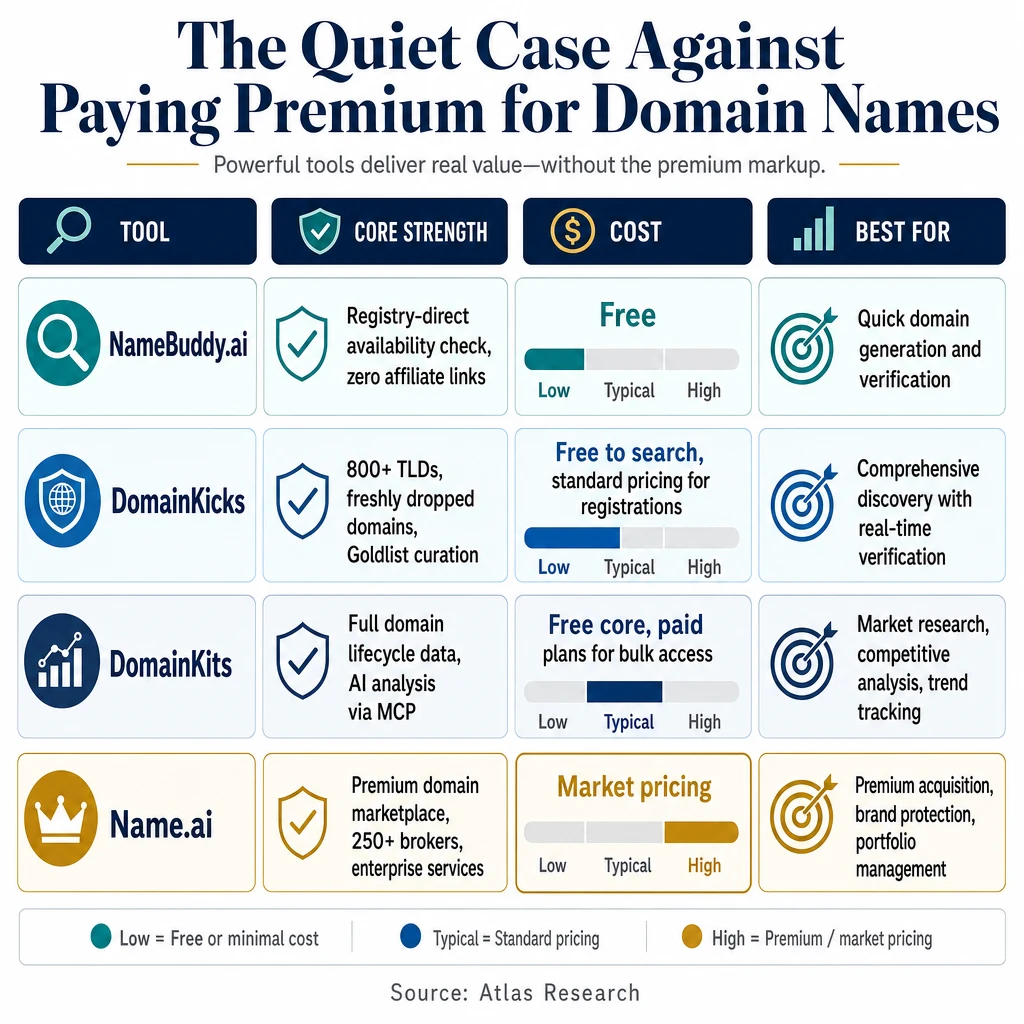
| Tool | Core Strength | Cost | Best For |
|---|---|---|---|
| NameBuddy.ai | Registry-direct availability check, zero affiliate links | Free | Quick domain generation and verification |
| DomainKicks | 800+ TLDs, freshly dropped domains, Goldlist curation | Free to search, standard pricing for registrations | Comprehensive discovery with real-time verification |
| DomainKits | Full domain lifecycle data, AI analysis via MCP | Free core, paid plans for bulk access | Market research, competitive analysis, trend tracking |
| Name.ai | Premium domain marketplace, 250+ brokers, enterprise services | Market pricing | Premium acquisition, brand protection, portfolio management |
The domain game is changing. Not because AI is replacing human judgment it isn't, and it won't. But because the information that was once locked behind professional tools and premium paywalls is now accessible to anyone with a browser and a project to name. That is worth more than the hype.