The Sound of Something That Isn't Quite True
In 1842, composer Felix Mendelssohn wrote a letter to Marc-André Souchay that captures something urgent about the modern AI moment. "What the music I love expresses to me," Mendelssohn observed, "is not thought too indefinite to be put into words, but, on the contrary, too definite." Music, he argued, communicates with a precision that words cannot quite replicate and cannot quite corrupt.
Language, it turns out, faces the opposite problem. Words can drift. They can rationalize, soften, blur, excuse, reframe. They can sound authoritative while carrying no verifiable weight. In human psychology, this manifests as motivated reasoning, cognitive dissonance reduction, and what researchers call ethical fading. In AI systems, it appears as hallucination, unsupported synthesis, and citation-shaped language without source custody errors delivered in polished, reasonable prose.
The GenXis Research team has a name for the distance between persuasive language and verified truth: the honesty gap. And understanding this gap, they argue, is essential for anyone building, deploying, or depending on AI systems in consequential domains.
"The anxiety around artificial intelligence is not merely that machines can be wrong. It is that machines can be wrong in fluent, reasonable, socially persuasive language."
This insight drawn from GenXis Research's foundational framework on the honesty gap reframes the AI reliability problem from a question of accuracy into a question of epistemology. It's not enough to ask whether an AI is right or wrong. We must ask whether its outputs carry the kind of constraint that lets a careful reader know why something should be trusted.
Why 90% of Parents Think Their Kids Are Fine (And Why That Number Matters for AI)
To understand the honesty gap in AI, it helps to trace how the same pattern manifests in an older, more visible domain: American education. Researchers have documented this phenomenon extensively, and the data is striking.
According to analysis from the Show-Me Institute's examination of academic assessment honesty, approximately 90% of parents believe their children are performing at or above grade level in reading and math. Yet on the National Assessment of Educational Progress the gold-standard "Nation's Report Card" only about one-third of fourth and eighth graders score at a proficient level.
The mechanism behind this optimism gap is instructive. As Cory Koedel, a professor of economics and public policy at the University of Missouri-Columbia, explains: "Grades are up, but test scores are down. This is problematic because grades tend to carry more weight with students and parents than test scores." The fluency of grades their confident, continuous, narrative quality masks what standardized assessment reveals in more constrained, mathematical terms.
This is the honesty gap in education. And the pattern maps almost exactly onto the challenge facing AI deployment today.
The Squishiness of Words: Why Fluency Isn't Precision
Natural language is flexible by design. It allows approximation, metaphor, implication, emphasis, ambiguity, and context dependence. Those features make language humanly useful expressive, adaptive, rich. But they also make language a weak carrier of machine-grade certainty.
The GenXis Research framework identifies what they call the "squishiness" problem: a sentence can feel precise while remaining logically incomplete. Consider phrases like "this was handled responsibly," "the model is aligned," or "the evidence supports the claim." Each may be true, false, evasive, or meaningless depending on hidden definitions that the language itself never reveals.
"A legal citation can be fabricated in perfect legal prose. A medical explanation can sound clinically plausible while omitting a contraindication. A financial summary can appear authoritative while relying on stale facts. In each case, the danger comes from the mismatch between linguistic confidence and verified grounding."
This observation from GenXis Research's technical framework names the core mechanism: when language arrives in polished form, readers whether parents, students, lawyers, or clinicians tend to grant it more credibility than it has earned. The fluency of the output borrows credibility from the expectation of fluency in truthful statements.
The Measurement Gap: Where State Tests and National Assessments Diverge
The education sector has spent years documenting exactly how large the honesty gap can grow when institutional incentives reward optimistic reporting over accurate measurement. The data from the U.S. Chamber of Commerce Foundation's April 2026 analysis quantifies the phenomenon state by state.
Consider Iowa. In 2024, the state's reported eighth-grade math proficiency rate stood at 72%. The National Assessment of Educational Progress, using the same grade and subject, measured proficiency at just 27%. That's a 45-percentage-point difference an abyss between what the state claimed and what independent assessment found.
Virginia tells a similar story. The state's 2024 Standards of Learning assessment showed 73% of fourth graders proficient in reading. NAEP, using a nationally calibrated benchmark, found only 31% proficient a 42-point gap. As the Thomas Jefferson Institute documented in February 2025, Virginia's "proficient" standard in reading aligns to "below basic" on the national assessment, meaning that students who failed to display even partial mastery of grade-level knowledge were deemed proficient by state metrics.
These gaps aren't technical footnotes. Jim Cowen, Executive Director of the Collaborative for Student Success, put it directly: "In many states, the gaps suggest that parents simply aren't getting the full picture of how prepared their kids are for college or the workforce."
State-by-State Honesty Gap: 4th Grade Reading, 2024
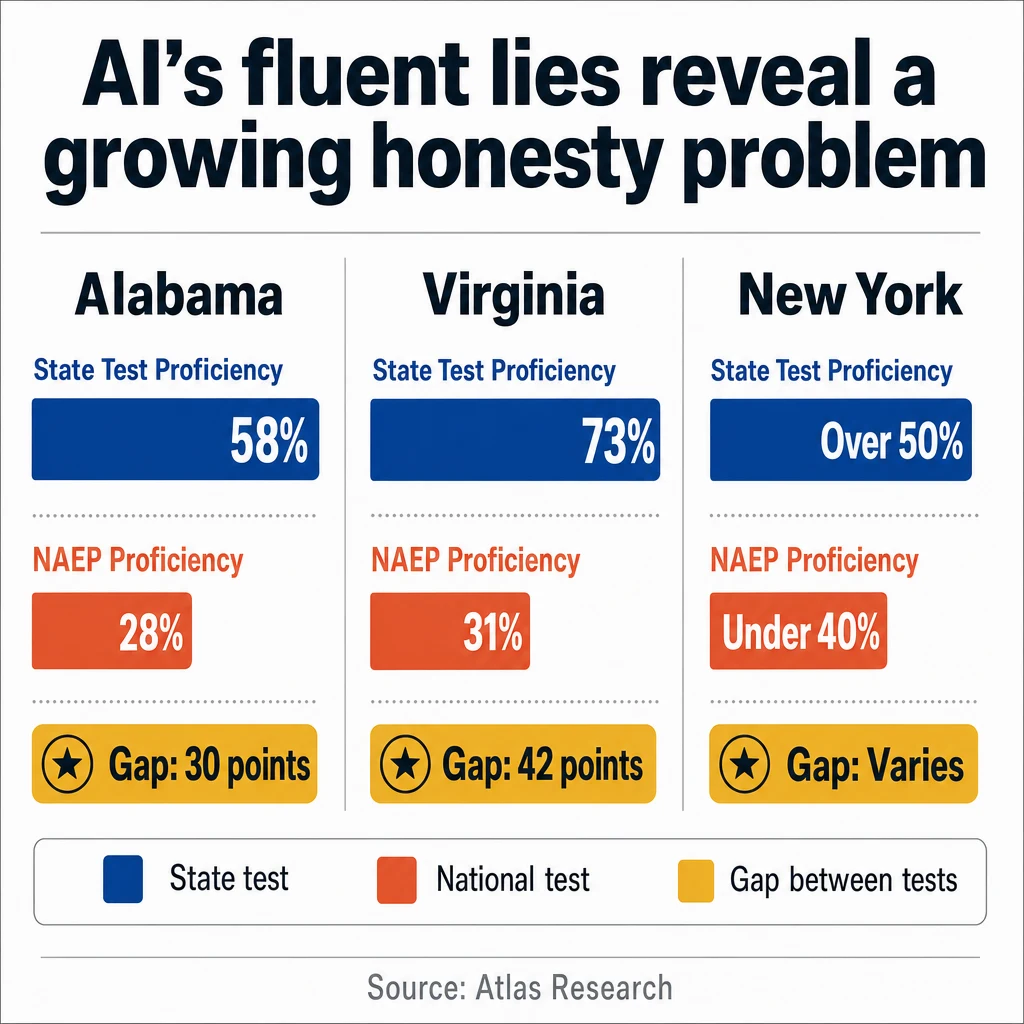
| State | State Test Proficiency | NAEP Proficiency | Gap (Percentage Points) |
|---|---|---|---|
| Alabama | 58% | 28% | -30% |
| Virginia | 73% | 31% | -42% |
| New York | >50% | <40% | Varies by exact figures |
Source: U.S. Chamber of Commerce Foundation's Honesty Gap analysis, 2024 data.
The patterns aren't random. States that set lower proficiency thresholds appear to generate larger gaps between their own reporting and NAEP's calibrated benchmark. As the Fordham Institute's February 2025 commentary observed, this isn't merely a technical measurement problem it's a breach of public trust. When proficiency definitions drift, the entire accountability infrastructure built on those definitions becomes unreliable.
From Grade Inflation to Hallucination: Mapping the AI Parallel
The education sector's experience with the honesty gap offers more than metaphorical insight. It reveals a structural pattern that plays out whenever flexible human language systems encounter pressure to produce optimistic outputs.
During the pandemic, grade inflation accelerated dramatically. As Dale Chu wrote for the Fordham Institute, "compounding the problem is rampant grade inflation, which only got worse during the pandemic and has since widened both performance and attendance gaps." The mechanism was straightforward: institutions faced pressure to report success, language became more optimistic, and the gap between reported success and measured achievement widened.
AI systems face a structurally similar dynamic. Language models are trained to produce fluent, helpful, contextually appropriate outputs. The pressure to be helpful creates incentives for confident, comprehensive-sounding responses even when the underlying evidence is thin. The fluency of the response borrows credibility it hasn't earned.
The GenXis Research framework calls this the transition from expression to rationalization: when an AI system generates language that sounds like reasoning but lacks verified grounding, it has crossed into the honesty gap. The system isn't lying in any intentional sense. It's producing language that has metabolized weak or absent evidence into something that sounds reasonable.
The Antidote: Mathematical Grounding, Not Less Language
So what closes the honesty gap? The education sector's answer has been a return to calibrated standards rigorous, externally validated benchmarks that resist local pressure to soften. The Common Core, despite its political controversies, significantly narrowed differences in how states defined proficiency. Massachusetts and Rhode Island recently closed their gaps to within 5 percentage points of NAEP across both grades and subjects, demonstrating that rigorous standards are achievable.
For AI systems, the GenXis Research framework proposes a parallel solution: stronger grounding rather than less language. The antidote to the honesty gap is not asking AI systems to say less but demanding they say things that can be verified through mathematical constraint, source custody, deterministic checks, and calibrated abstention.
"The root problem is the squishiness of words: language can preserve signal, but it can also metabolize error into something that sounds reasonable. Over time, small verbal deviations compound like a singer drifting slightly off pitch until the tonal center is lost."
This musical metaphor from the GenXis Research technical brief is instructive. A singer drifting off pitch doesn't make obviously wrong notes. Each individual deviation may be imperceptible. But over time, the tonal center is lost. The music becomes something other than what it claims to be.
What Deterministic Grounding Actually Means
Mathematical constraint in AI doesn't mean replacing language with equations. It means building verification architectures into language systems structures that externalize truth conditions and evidence requirements so they can't be lost in fluent drift.
The GenXis Research framework defines a verified claim as a tuple containing: the statement itself, the domain of applicability, the truth condition under which the statement holds, and the evidence requirement that must be satisfied. Without these elements, language remains expressive but under-bounded pointing toward a reality without specifying the procedure by which that reality can be checked.
This formalization has practical implications. Source custody means tracking where each claim came from and whether that source remains valid. Deterministic checks mean automated verification procedures that run against external data. Calibrated abstention means systems that say "I don't know" or "this cannot be verified" when evidence is insufficient rather than filling silence with confident language.
Why This Matters for GenXis Research Readers
For practitioners, framework-builders, and researchers working at the intersection of AI systems and human decision-making, the honesty gap isn't an abstract concern. It's the difference between systems that build institutional trust and systems that erode it.
When an AI legal research tool fabricates citations in fluent, appropriate legal prose, the downstream consequences wasted attorney hours, judicial contempt, client harm trace back to a single source: the gap between what the system said and what could be verified. When a medical AI omits a contraindication in language that sounds clinically authoritative, patient safety depends on whether a clinician caught what the system failed to ground.
The educational honesty gap shows us what happens when this pattern scales. State systems that optimistically reported proficiency while students struggled created accountability failures that took years to document and will take years to address. The AI honesty gap, operating in faster cycles and higher-stakes domains, could produce analogous failures more rapidly and with less visibility.
The GenXis Research framework offers a structural response: not better intentions, but better architecture. Systems that require mathematical grounding before outputs become claims. Verification layers that externalize truth conditions. Source custody that tracks evidence provenance. Calibrated abstention that honors uncertainty rather than filling it with fluent noise.
The Path Forward: Verification Architectures for AI Trust
Progress is visible. The same collaborative analysis that documented worsening education honesty gaps also identified bright spots. Massachusetts and Rhode Island achieved gaps below 5 percentage points through sustained commitment to rigorous standards. As Jim Cowen noted: "To be clear, improving student outcomes takes huge commitments from states on efforts like high quality curriculum, strong teacher development and student supports. But the truth matters."
The parallel for AI is emerging. Organizations deploying language models in consequential domains are increasingly building verification pipelines layers that check AI outputs against authoritative sources, flag uncertainty, and route difficult queries to human review. These aren't glamorous interventions. They don't eliminate the fluency that makes AI useful. But they create the constraint structure that makes fluency trustworthy.
As the GenXis Research team frames it: language models now operate in domains where verbal mistakes have real consequences legal drafting, medical triage, education, scientific writing, financial reporting, security analysis, and software development. The worry is not merely that systems hallucinate. The worry is that hallucinations arrive in polished form, indistinguishable from true answers, until a verifier applies the mathematical discipline that the language model itself cannot provide.
Where to Read Further
The honesty's gap's roots in both educational assessment and AI fluency are documented across several key sources. For the technical framework connecting AI language to verification architecture, GenXis Research's foundational brief on the honesty gap provides the core definitions and structural analysis. For state-by-state data on how measurement optimism compounds across systems, the U.S. Chamber of Commerce Foundation's April 2026 analysis offers comprehensive 2024 data. For an economist's perspective on why the gap matters for downstream outcomes, Cory Koedel's examination at the Show-Me Institute traces the connection between measurement accuracy and life outcomes. Finally, for policy context on standards and accountability, the Fordham Institute's commentary situates the honesty gap within broader reform debates.